10.23.2010

Containing a tangible sense of history 

that seems woven right into the wool. A memory of a horse's flanks steaming on a winter's night. The creak of the carriage traces as the horse waits, the snow melting into the wool.

Antique horse blanket, luncheonettevintage
In a flickr stream of the NY fire department museum, a similar blanket. Same berry red stripes, same goldenrod yellow, same woven, slightly coarse by soft wool.

NYC fire dept. horse blanket, Mitchell Klein
Another horse blanket at the Orange County fire museum, from the 1880s.

Parade blanket for fire horse, Orange County Fire Museum
And then, jumping around, found an entry on the triangle shirtwaist factory fire: that firemen tried to catch the falling women with a horse blanket. With vintage comes the past.

10.21.2010

Not all twee 
Silent movie treasury by coolranchstudio
The treasury that was on etsy's front page from 9 to 10 am had nary a blossom or a teacup or a whimsical fairy digi-card to be found. Nothing against blossoms or teacups. And here's the row that got left out of the FP. It includes more essentials: old photo, brush, fantastic collar, great ring. Worth clocking on for the terrific sellers represented, too. And confirms my endless affection for grey and midtone neutrals.


Curator: coolranchstudio. I'll say. Big piece of pie coming your way.

10.20.2010


Nearly 4 weeks old.


Oak leaves and tupperware tumblers through the viewfinder of the Duaflex, Tuesday morning.

10.17.2010

Vintage weekend afterburn

Timber wolves by Frederick Remington, vintagesuburbia
 There was a lot going on this weekend that had nothing to do with vintage. It was supposed to be that way. There was grocery shopping. There was writing. The landscape in my novel suddenly had to change. Or so I thought it should. I wanted to turn the bowl-shaped valley that the wolves live in into a hollow, or a clove, something that seemed more jagged and less tyrolean. That set off all sorts of revision-hell alarm bells. Consistency rebricked across all those pages could be the death knell, so after toying with it, I temporarily gave up.

1960s rat pack tuxedo, fabgabs
There was work. I interviewed a haberdasher for an upcoming article. I love interviewing haberdashers. He said, "Men no longer want a big silhouette. They want that slender, throwback, lean and mean fit." He said, "Black is the new black."


Colette in a suit, being brilliant back then
And I had to finish editing a kind of magnificent, far-reaching text by someone who is clearly, and I say this with no irony, brilliant. And clearly, in a slightly wild-haired way that somehow reminds me of Colette, of his own mind. And I had to query him, in English, through a few intermediaries, and hope the answers would somehow sieve out of German and back into English in a way that I could then blend them, a la Smitten Kitchen, deftly back into the batter, so to speak. And it worked, in the end, into a smooth, kind of peppery mix.

1970s-1980s pumps, and not the ones that smell that I talk about below. These ones don't smell at all. The ones that smell I wouldn't photograph. Somehow it might show up in the image, like a yellowish haze. These pumps are an unscented size 7.
As I write this I am sitting with a pair of old pumps on my lap that smell like stinky old shoes. I have been inhaling shoe stink somewhat unconsciously, until the last few moments, when it got — profound.

Just 5 of the pulp stack, a small fraction of the lurid cache. Coming soon to the luncheonette.
And just to the left of the laptop, towering behind the screen in a kind of tawdry jumble of type and color, is a stack of pulp mysteries and crime novels from the 1950s with names like Night at the Mocking Widow and Dardenelles Derelict. I'm going to sell them in the luncheonette for a friend. We had a blast going through the titles, the covers, the luridness of it all. And next to them is a stack of vintage cookbooks I am obsessed with, which have instructions like, place in a quick oven and bake, and be sure to save the drippings in a can for later: a thrifty kitchen is a practical kitchen!

Not from the back of a cookbook, no. You're right.
The point is that a weekend that was supposed to be very much not about vintage became a weekend in which vintage held me in thrall, in all its enigmatic impossibility, its time warp, its fragility, its other-time-ness. It called to me as I worked, cooked, ran. It created conundrums and commotion. It busted a little hole through the real-time sky.


At a barn sale one town over, I found an old 1950s lace cocktail gown, strapless, with peach-colored lace so delicate it threatens to fall apart at a lady's exhale, and dove grey trim around the bodice that has an unsettlingly mottled look over one side. It is, of course, tiny, and yet the chest is made for someone on the Jane Russell side. And on Beulah it does nothing, just hangs there limp like it's about to play bass at a Hole show in 1996. 


This is a beautiful dress, but it's beautiful more like bleached out Edward Gorey than like the hell-cat curvaliciousness of a thriving retro frock. In other words, it looks anemic. It makes Beulah look like a Greek statue in drag.

I have to figure out what to feed it to bring back its bloom. How to treat it. How to write about it. How to photograph it so it doesn't look like a dress stuck on doll parts, because on Beulah it looks, just, sad. So this is perhaps the crossroads dress that will finally make me forsake Beulah, in all her flea-bitten rickety wonder, for a more sleek, vanilla-linen-covered dress form that doesn't maw apart at the ribs or crack open at one rear hip panel. A Wolf? A Baumann? Would that I were so lucky.

Beulah was built about a hundred years ago and does not entirely resemble so much as confound the contours of a woman's body. She is probably more like the Victorian, bustled, chest-forward, corseted ideal of a body. With a hole in its skin and that smell, like pie. Better, I suppose, than the shoes, which I'm about to de-scent using my secret recipe, gleaned from an old cookbook, actually, written for clueless young brides.

Happy Sunday.

10.16.2010

My wholesome vintage sisters

Somehow, reading a little piece that asks why Betty has to be so bad (and getting worse) inspired this little assembly, soon as I got in from feeding the chickens. There's something about the way each, ahem,
Sulphuric acid bottle, domestikat
object is centered in the frame (that necklace, that there bauble, it's centered left to right, ok?) that kicks it up a notch. I'm all for artful off-centering, and props like lace and doilies and moss. Etsy has
1950s picnic spoons, ameelia bedelia
so much moss. It's pretty mossy if you think about it. Etsy has as much moss as the church basement sale has extra large turtlenecks. But that's just it. Sometimes fussing up a picture makes it kind of —
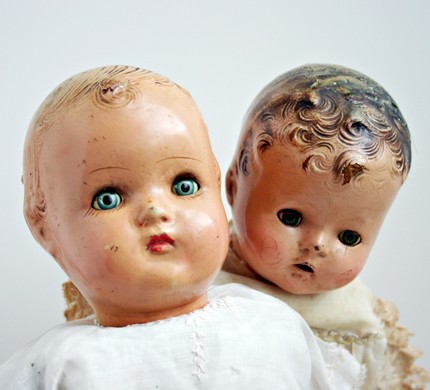
Antique baby dolls, zinniacottage
mossy. Like unbrushed teeth. Not very Betty at all. But the wholesome thing is not really a priority here, right? We're not being nostalgic. We're being — centered.
1950s leopard necklace, carmenandginger
Ashtray by dale chemical, retroburgh


10.15.2010

Xavier

Full name: Xavier vom Schutzberg, Son of Lee. Short name: X. Nicknames: X-box. Knuckle-ex. Dingbex. New skill: sitting still. For a full two minutes. Old skill: barking like Enrico Caruso.

10.09.2010

New writing, old church

Today is another delicious writer's marathon, the COTA readings at the Walloon Church in New Paltz. Twenty minute meals of poets and fiction writers and writers of other ilks, boom boom boom, part of a whole art-filled day: dance, installations, sculpture, music. I'm reading at 1:40, one of the eager jets taking off from this literary runway.  Planning on reading Galletas, just because I hardly ever do, and it does that 20 minute thing with room to spare — possibly for a scene from the new book. Always look forward, someone once told me. And keep it neat.

What really gets me going is reading in this old church, on this very very old street, I mean back to the 1680s kind of street. Old French Huguenot and Dutch gravestones tilt and hunker and shrug at each other in the graveyard right outside. New Paltz was founded by the French Huguenots, and Huguenot Street has some kind of honor as the oldest continuously settled neighborhood in the country. That's hundreds and hundreds of years of tricycles, bread, money, old cabbage leaves, cars and horses and worn down boots, winters, falls, rain, heat.

Graveyard, Walloon Church, New Paltz
Ulster county has lots of traces of old Dutch around. The buffet at Eng's Chinese Restaurant in Kingston is called the Smorgasbord, and everyone, including three year old tow headed boys, knows how to say it. The Pine Hill Bakery has Dutch shoes decorating the corners, and one nailed to a tree, higher up than anyone could reach. The old French culture, les Walloons, the protestants — is right here too, but often overlooked. But New Paltz is named for a village in Germany that sheltered the Huguenots. It's not Dutch. The name DuBois, not the Blanche kind but the Louis kind — traces right back to one of the first French families. New Rochelle, down south a good ways, is Huguenot. Staten Island's south shore. History is a 9,000 layer cake, baked during endless arguments, conflicts, migrations — so often about the divine. Divine providence as persecution, as run away and settle, as make a deal with the Esopus and build a hut, build another. Hate to ship to water to shore and logs to stones to arts festivals. My mother hated organized religion, bless her atheist modernist soul. But without it, we wouldn't necessarily be here.

10.08.2010

Sublime inhabitants of the world we just visit


while we place what we can where we can


pretending to hope it will stay there


when we'd rather it took to the air

10.05.2010

Department of Since You Asked: A-okay with Jo-o-Kay


The Grits n Ham suede jacket — came through the doors at the luncheonette, made a brief stint on etsy, and wound up in Utah, beloved at last.
Amazing, and amazingly weird at the same time!! It is so retro, but in such GREAT shape!! Was it yours? Thanks for everything ... Do you know anything about it?
—Feedback from the woman who bought the 1970s Grits n Ham suede jacket, from the luncheonette.

My answer: It wasn't mine, though it would have been if it and I had crossed paths in the past.  Especially if I'd come across it in college, when I was a double major, one of those majors being History, which serves pretty well when it comes to researching a jacket like this.

Nearly everything that comes through the luncheonette gets a pretty thorough working over: I start with the label, go through trademarkia, patent archives,  old ads (often found on *bay), legal records.

Letter written from Ardmore Air Force Base, 1943. The writer says, I have been to Ardmore once and I don't think a hell of a lot of it.
From a site on Oklahoma history, I found out that Jo-o-Kay is a trademarked name that isn't in the trademark archives. But it stands for John and Kay (Katherine) Simpler, of Ardmore, Oklahoma. Actually they weren't technically of Ardmore, they were of somewhere else, but they moved to Ardmore in the 1950s, after the owner of the Western Supply Company encouraged them to. Western Supply made leather goods, specifically the hand-tooled kind, and the owner's family and the Simplers would have cookouts every Saturday night once things got going. The suede and leather coat business started, probably, as a discussion over hamburgers on a buggy night. Imagine everyone, filling up on good Okie beef and looking towards fall. Everyone needs a good jacket, after all.

Main Street in Ardmore, 1958.
 John and Katherine wanted to call it Jo-Kay. But Jockey, already making underwear, paid for them to add an extra o into the name. As if someone might confuse a two-tone, snap-close cowhide leather jacket with a snazzy cowboy yoke for a pair of Y-fronts. At any rate that's what the Simplers did, though locals always called it Jo-Kay.

A later 1970s label (which, upon second thought, makes me wonder if the Grits n Ham jacket was actually from the 1960s)
And here's an excerpt straight from "The Year of the Campus Cowboy" in a 1964 Sports Illustrated:
Rough-out leather jackets, cut, stitched and snapped like a wrangler's denim model, are hotly popular in the West and are now turning up in the East as well. One firm, Jo-O-Kay of Ardmore, Okla., has sold 100,000 of them this year in 42 different models. They are made of brushed cowhide, lined in warm Orion fleece. Mike Irving and Justine Purdy wear rough-outs over snug-fitting cowboy shirts in Ivy League stripes.
Can't find the photo, but here's the caption: 
This page, above: Both jackets are by Jo-O-Kay; the man's, in Aztec gold color, is $30, the lady's $29. Both are at Granby's Trading Post; Miller's; Western Ranchmen Outfitters.
 Western Ranchmen outfitters is still in Cheyenne, Wyoming. Members of the Simpler family are still in Ardmore, having cookouts. At some point, the Tandy Company bought Corral Sportswear, which carried — or oversaw some aspect of (and this is where the research gets spotty) Jo-o-Kay. At some point Jo-O-Kay began making coats and jackets for Corral. And someone named Simpler — and it might have been John Simpler himself — was interviewed during a National Labor Relations Board Hearing on whether or not the Ardmore plant had conspired against AFL-CIO members who wanted to organize. That was in 1966-1967, when Corral Sportswear's Ardmore Oklahoma plant — at least this is how it's described in the NLRB transcripts — was found guilty of conspiring against union members by the National Labor Relations Board. The union had petitioned to hold an election at the plant, and among the winners were union members then contested, said the NLRB, by management. Managment being a Mr. Simpler. The plant had 96 employees, but there were only 76 voters:
76 voters-- 1 janitor, 1 patternmaker, 11 cutters, 3 set-up department employees, 3 finishing department employees, 2 shipping department employees, 6 linegirls, and 49 employees performing other work. All voted, as earlier indicated, with 5 challenges made. The Company challenged Pat Wilson, a set-up department employee, as a supervisor; the Union challenged Velma Trent, a finishing department employee, as a supervisor; the Union challenged Myrtha Heartsill and Gladys Roberts,6 linegirls, as supervisors; and the Union challenged Ruth Wills, the patternmaker.
The details of the case are a bit sad: you can imagine the group of employees hoping to do some good, imagine Mr. Simpler hoping to stave off changes that might lose him money, imagine the Union lawyers interviewing him, cross-examining him, when all he wants to do is go home and have a good steak. And it gives you a glimpse into how coats like this were made, by patternmakers, and cutters, and finishers, and linegirls, and a tiny shipping department, and by women with names like Myrtha Heartsill and Velma Trent.

And that's what I found out about the Grits n Ham jacket.

9.29.2010


Vintage as a black and white cookie

Glaser's Bake Shop black and white cookies
This week, like nearly all of them, has not gone as planned. The chicks are doing marvelously but the camera makes them panic, so pictures are forthcoming once they are more used to the giant black spectre of a digital SLR in their midst. The chicken coop has arrived, brought on a Ford F350 and a pneumatic hydraulic superflexible trailer, driven by a man wearing an FD hat and sweatshirt and ghillie-toed logger boots. And levi's. It made me think, the sight of those big macho boots (he had big feet) with the frou-frou, snaz-ola touch of the kiltie toe. A functional part of the boot's design with a purpose: to block embers, protect the upper from chafing from laces. But they look fancy, regardless. They do.
The toe in question, called a Kiltie, looks fussy but has a purpose.
Same toes, not the same purpose. Vintage Italian Bruno Magli loafers.
Why do people wear what they wear? Why do they pick what they pick? Which me straight to the revelation of the black and white cookie.

Glaser's Bake Shop. 87th Street, First Avenue, NYC.
The point is, the black and white cookie is a flexible entity that can be savored and considered in many ways (Seinfeld, etc). 27 people might have one and noone will eat it the same way. And, incidentally, it started as a way to use up leftover cake dough — waste not in ye olden days. It is at least 108 years old: Glaser's, a famed old world bakery that happens to be in my sister's neighborhood, has been making them since the opened in 1902. Which makes it bona fide vintage.

Manning the ovens at Glaser's, some years ago.
And that fondant icing, made of simple ingredients, adds up to more than the sum of its parts. Like great outfits. Like a great piece of vintage, that emanates something far more than a piece of cloth with seams. We all know the phrase: a Peggy dress,


A Joan dress.


Means a world. Come to think of it, how many times do we see Joan in a black and white dress? Doesn't suit her. There's nothing really black and white on her surface, though there is,
I think, on the inside. Her curves have their own morality.

All from Simply Vintage treasury by cabinwindows
The thing about black and white cookies, which belong to the honored category of Food That is Vintage, is that they are stark and yet they are delicious. They are geometrically divided, they are round, and yet they have that warm, crumbly potential you can taste before you start eating. Vintage is that way, or can be. In black and white, it can look even more luscious. The forms come out, the lines, the retro, old-school, antique mechanics. You can nearly see the drafter's pencil at work, the giant shears at the tailor's. Cabinwindows is the etsy moniker for a biologist and anthropologist who made the treasury excerpted above. Black and white. She grew up watching biology filmstrips, lives in a haunted cabin, and she gets the black and white cookie of it all.

9.19.2010

Dress that cupcake #2

See the first post for the concept, in which I decided that instead of creating an outfit from a room (did Domino do that?) or a room from an outfit, we should really get to the basics here and dress an outfit from the most fundamental food, the cupcake.


cupcake/outfit

cupcake: red velvet cupcake with creamcheese frosting, mingmakescupcakes
outfit: 1970s oxblood gathered vegan handbag (ever since I found out a vegan baker
won the cupcake baker reality show I've been into vegan as a cupcake concept), rustbeltthreads
1960s red velvet babydoll dress (red or not,
this is a remarkable dress!), thrush


chalcedony and silver necklace (luminous, hot, and
beautifully made), polestar
1960s Air Step nerd heels (but the shoes really should go with the dress), lisazain

1960s Copenhagen poncho (another phenomenal piece), veritevintage
Vintage lotto marker bobby pins (imagine how adorable), factorygirlashli
long cuff mittens like Bella's in red (ok, sure, like Bella's, but also like my Auntie Deena's, and she remains my personal 60s icon), ilZdr